Most people photograph Kraków from a distance. The Main Square at golden hour, the towers of St Mary’s, the whole sweep of the Cloth Hall. I did too, on the first morning. Then I put the wide lens away.
What stayed with me from this trip wasn’t the skyline. It was a shadow on a wall, a chipped cup on a scratched café table, and a ring of bread sold from a blue cart for one euro. This is the kind of shooting I do most: details, in restaurants and hotels and on the street outside them, usually fast and usually with whatever light the room happens to have.
So here are five photographs from one September morning, and exactly how each one was made.
The lantern that draws itself
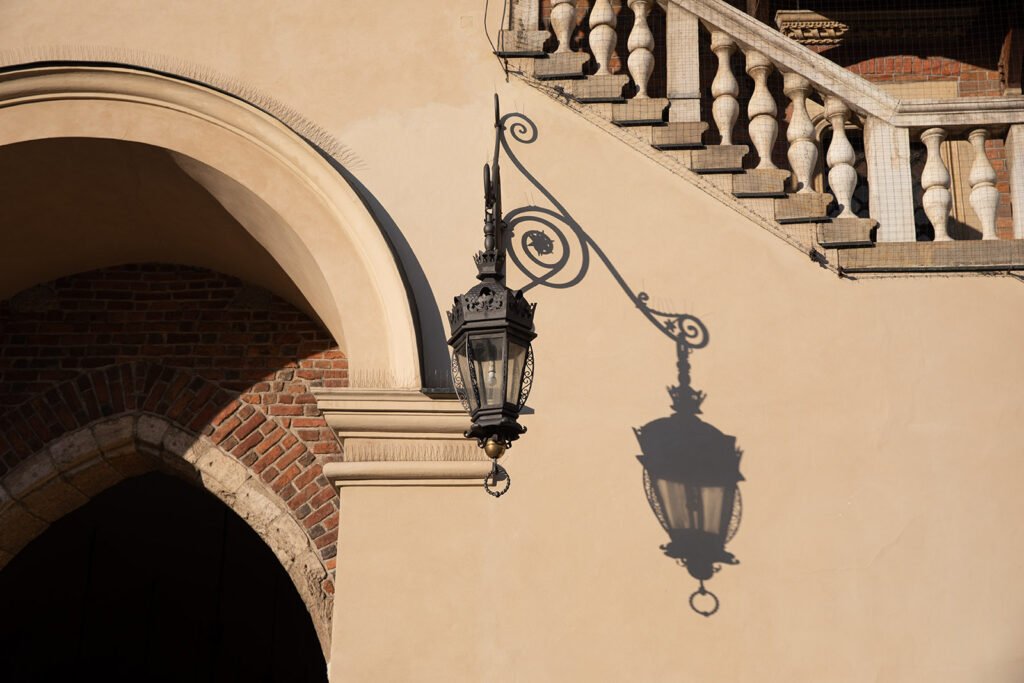
The first thing I noticed wasn’t the lantern. It was what the sun was doing with it.
Low September light hit the wrought iron at the right angle and the wall became a canvas. Every curl of the bracket, every point of the little crown on top, printed itself onto the plaster in clean grey. The real lantern is heavy. The shadow floats.
How I shot it. Hard, low, side light is the whole picture here. That means the first two hours after sunrise or the last two before sunset. By midday the sun climbs and drops the shadow directly underneath the object, where it’s useless.
Expose for the bright plaster rather than the dark iron, and let the lantern go almost to silhouette. If you try to save detail in the metal, the wall blows out and you lose the shadow, which is the actual subject.
This shot existed for maybe forty minutes. An hour later it was gone.
Coffee before the city wakes
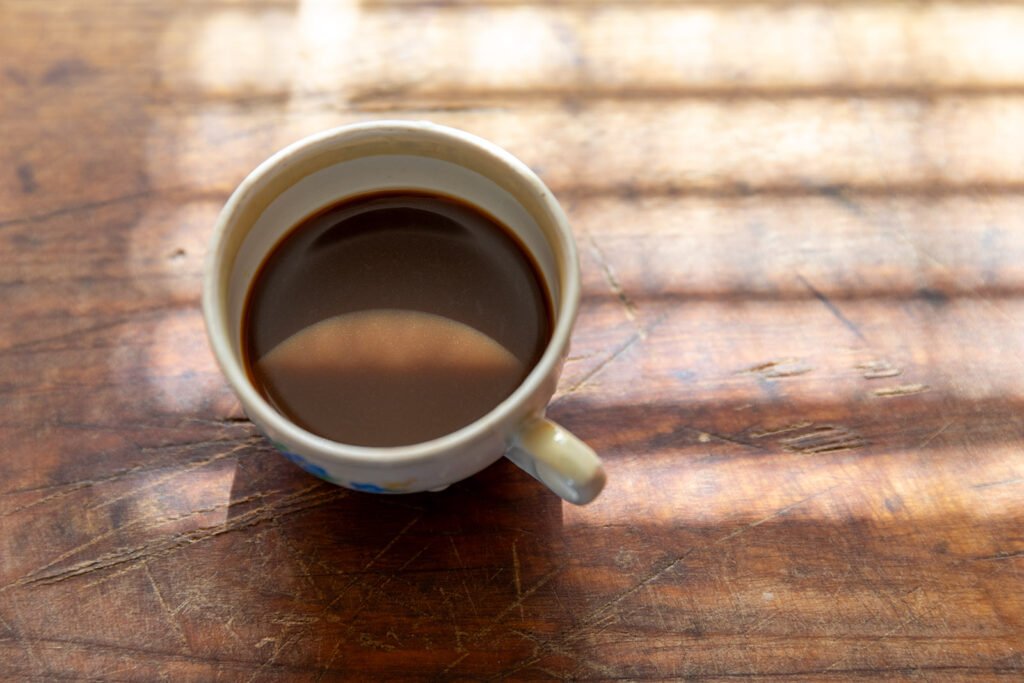
A small cup, a wooden table worn down by decades of elbows and cutlery, and a band of window light lying across the grain.
I love the table more than the coffee. The scratches, the split running along the board, the dark patina at the edges. In food photography we spend real money hunting for surfaces that look like this, and here it was, just a café table doing its job.
How I shot it. Choose the table, not the dish. Walk in, find the window, and ask to sit next to it. One good window does more for your photos than any amount of editing.
Put the light to the side or slightly behind the cup, never behind you. Backlight and sidelight give liquids that glow and give the surface its texture; front light flattens everything. Shoot from about 45 degrees or straight down, never from sitting eye level, and open up to f/2.8 or f/4 so the far edge of the table dissolves. I kept the cup off centre and let the diagonal of light do the composing.
And no flash in a restaurant. Ever. It kills the atmosphere you came for, it bothers other guests, and it’s the quickest way to be asked to stop. Push the ISO instead — a little noise at 3200 beats flat flash light every time.
Four złoty, one euro
Then the blue cart.
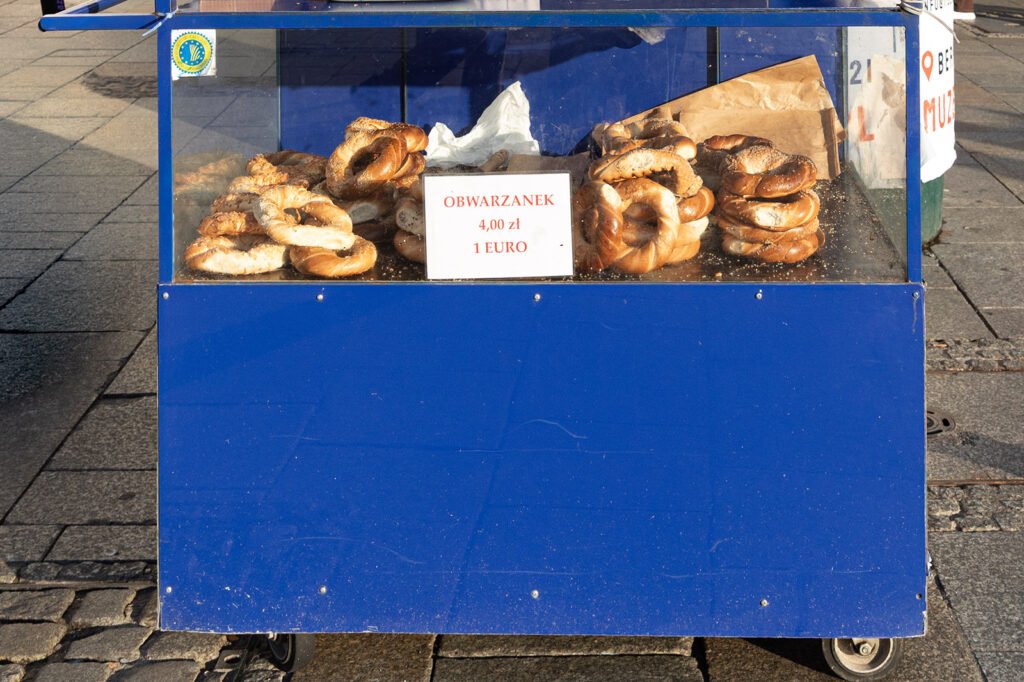
These are everywhere in Kraków, parked on corners before eight, glass boxes full of braided bread rings. The hand-lettered sign says it plainly: obwarzanek, 4.00 zł, 1 euro. In the corner of the glass there’s a small blue and yellow EU sticker — the protected geographical indication seal.
How I shot it. For a flat, graphic subject, stand square to it and centre it. No clever angle needed. Stop down to f/8 so the sign stays crisp and readable, because handwritten signs and prices are what date a photograph in the best possible way. In five years the price on that card will be the most interesting thing in the frame.
That big panel of cobalt blue against grey cobblestones is the strongest colour in the whole set, so I gave it room rather than cropping tight.
Six hundred years of the same bread
That blue cart is the end of a very long story.
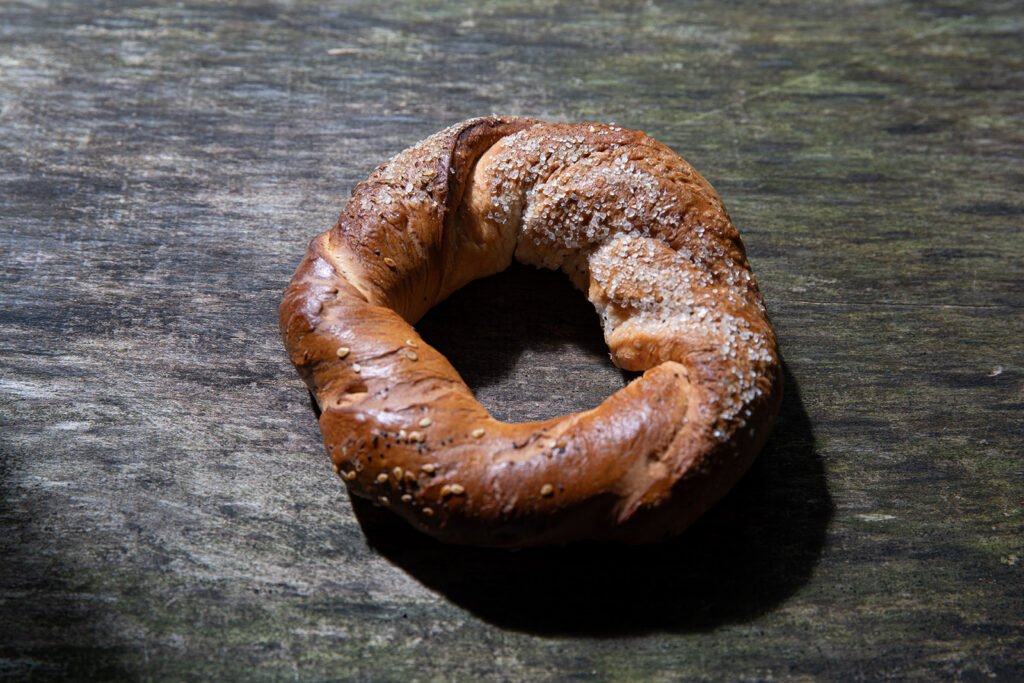
The first written record of the obwarzanek comes from the household accounts of Queen Jadwiga and King Władysław Jagiełło. An entry dated 2 March 1394 logs a single grosz spent on rings of obwarzanki for the queen — the clerk wrote the name in both Polish and Latin, and the Latin words, circuli and circinellos, simply describe the round shape. So when you buy one on the Main Market Square today, you’re buying something that was already worth writing down in a royal ledger six hundred and thirty years ago.
The name itself describes how it’s made. It comes from obwarzać, meaning to parboil, because the dough is boiled before it goes into the oven. That’s what gives it a crunchy golden crust over a chewy, faintly sweet interior — and it’s why calling it a bagel or a pretzel will earn you a look from any Cracovian within earshot.
For a long time it was a seasonal thing. Obwarzanki were baked only during Lent, by specific bakers working inside the city walls, and sold from stalls around the Cloth Hall. Then in 1496, King John Albert granted the Kraków bakers’ guild a monopoly on baking white bread, obwarzanki included — a privilege confirmed by every Polish king down to John III Sobieski. The system stayed tightly controlled for centuries. A decree of 22 January 1802 finally opened it up, letting any baker make obwarzanki when his turn came around, with the turns decided by drawing lots.
And then, in a neat historical loop, the protection came back. In 2010 the European Commission granted the obwarzanek krakowski Protected Geographical Indication status, with a certificate fixing its weight, its shape and the way it must be made. Only bakers in Kraków, or in Kraków and Wieliczka counties, may produce it. That small sticker in the corner of the cart’s glass is the 1496 privilege, reissued by Brussels.
Two things worth knowing if you want a good one — and they matter as much to the photograph as to the eating. An obwarzanek has a useful life of roughly three hours out of the oven, so buy from a cart being restocked rather than one that’s sat since morning. And a genuine one carries long marks on its underside from the baking process. Turn it over before you shoot it: a tight overhead of the base, with those marks and the uneven scatter of salt, is a stronger and far less photographed image than another shot of the top.
The bread itself
Back at the apartment, I put one on a weathered grey board near a window and closed the curtains almost all the way.
This is the one I’m proudest of. The obwarzanek is a wonderful subject: hand-twisted, so no two are the same shape, glossy where the egg wash caught, matte where the salt sits.
How I shot it. One light source, cut down to a narrow slice. Curtains nearly shut, subject close to the gap, and a dark jacket propped on the opposite side to stop any light bouncing back and softening the shadows. The light comes from behind and to one side, which is what makes the salt crystals and poppy seeds catch and sparkle — front light would have made them disappear.
Expose so the highlights on the crust just hold their detail and let everything else fall away into the dark. Dark, moody, one object, one light. The simplest setup is often the right one, and it’s one you can reproduce in any hotel room with a window and a towel.
Remember the three-hour rule. You have roughly an hour of usable time after buying before the crust dulls. Buy it, walk it straight back, shoot it, then eat it.
A door that still works
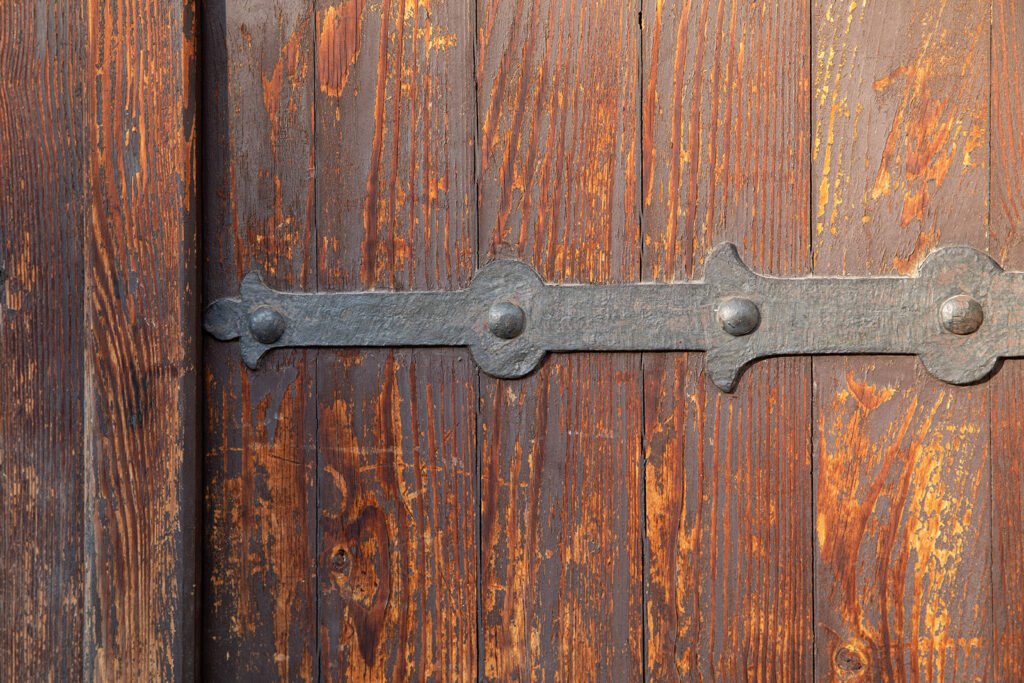
Last, an old door — or rather one small section of it.
Layers of dark paint worn back to raw pine, a hand-forged iron strap hinge, four domed rivets. Nobody restored this door, which is exactly why it’s worth photographing.
How I shot it. Fill the frame and cut out all context. No doorway, no street, just texture and the one straight iron line crossing all that vertical grain.
Stand parallel to the surface and keep the sensor square to it, otherwise the boards lean and the pattern loses its structure. Side light is essential here too — flat frontal light turns weathered wood into a flat brown rectangle, while raking light brings out every crack and paint edge.
What I’ve learned shooting in restaurants and hotels
These five images are all details, and that’s deliberate. Wide interior shots are hard to do well, and every decent hotel already has professional ones. What venues don’t have, and what they genuinely want for their own channels, is a beautiful close-up of one cocktail, one hinge, one folded napkin.
A few things that make these shoots go smoothly:
- Ask the right person. The manager or the host, not a server mid-service. “May I take a few photos of the room and my food?” is nearly always yes. If you’re shooting for a blog or a collaboration, say so at the start and offer to tag them.
- Go at the dead hour. Between two and four in the afternoon, restaurants are empty and staff have time. Hotel breakfast rooms are best just before service opens or right after it closes.
- Move the plate, not the furniture. Sliding a dish into better light or turning it to its best side is normal. Rearranging a whole table or moving a property’s decor is where you lose goodwill.
- Carry very little. One body, one fast prime, no tripod. Tripods are what get you stopped in lobbies, and a wide aperture does the same job.
- Work fast on food. Hot food photographs well for about ninety seconds. Foam collapses, steam stops, ice melts. Set your angle and settings before the plate arrives.
- Respect the other guests. No stranger’s face in your frame, no leaning over someone’s table, camera down if anyone looks uneasy.
- Send the photos afterwards. Three or four edited images by email, no strings attached. It costs nothing, it’s why people say yes the second time, and it’s how one meal becomes an ongoing relationship with a property.
And then put the wide lens away
Five photographs, one morning, one small corner of a city with plenty of grand things to look at.
If you’re going to Kraków with a camera, shoot the famous views on your first morning and get them out of your system. Then spend the rest of the trip looking at walls, doors, tables and carts. That’s where the city actually lives, and it’s where the pictures nobody else has are waiting.
One last detail: in 2010 the obwarzanek krakowski was granted EU Protected Geographical Indication status, with a certificate fixing its weight, its shape and the way it must be made.
If you want the rest of what I ate in Kraków, it’s all in my Kraków food guide.